What Are the Holy Books in Islam https://www.alfatihaonlinequraan.com/

What Are the Holy Books in Islam? Their Prophets, Revelations, and Teachings

What Are the Holy Books in Islam? Their Prophets, Revelations, and Teachings

Islam is a unique religion which puts great stock on revelation and encouragement from Allah through his prophets. These holy books, as the Islamic doctrines, are claimed to be helpful for spiritual and practical purpose of humanity. Each book was brought forth in its time and for the people and inversely reminded of the monotheistic faith. In this article, the holy books in Islam, the personalities to whom these books were granted, and their role with the support of references to Quran will be described.

The Quran: The last message of Allah to the Prophet Muhammad PBUH

The Quran is the last word from Allah and the holiest book whose revelation was made on Prophet Muhammad (PBUH) for a period of two decades and 300 nights. The Quran is in Arabic language and is divided into 114 surahs containing together more than 6000 Ayahs. It is unaltered and is the key reference and authority by which Muslim’s lead their lives.

Allah describes the Quran as a comprehensive guide for humanity:

“This is the Book about which there is no doubt, a guidance for those conscious of Allah.” (Surah Al-Baqarah: 2)

From the Quran examples of instructions for personal conduct, social justice, worship, and spirituality can be drawn. It re-emphasises the doctrines of earlier scriptures. The Quran believe in the sovereignty of Allah, his unity, the reason for existence, and reckoning in the here after.

Prophet Muhammad (PBUH) is referred to as the “Seal of the Prophets” and the Quran confirms his role as the final messenger:

“Muhammad is not the father of any one of your men, but he is the Messenger of Allah and the Seal of the Prophets.” (Surah Al-Ahzab: 40)
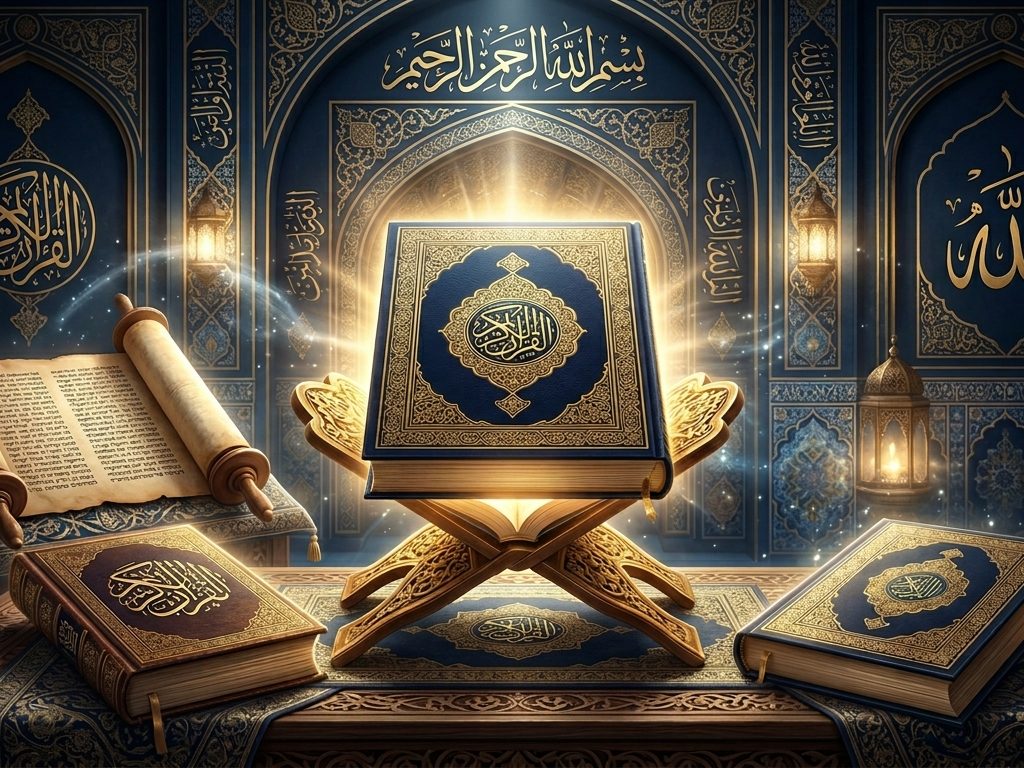
Islamic books alfatiha online quraan institute

The Torah (Tawrat): to Prophet Musa (Moses)

The Torah is of Israel and sent through Prophet Musa (Moses). In it, they were given rules and regulation, as well as prohibition that will assist them in the way they worship Allah, as well as the manner they deal with injustice within society. The Torah is one of the earliest divine books mentioned in the Quran:

‘“Indeed, We sent down the Torah, in which was guidance and light. The prophets who submitted [to Allah] judged by it for the Jews, as did the rabbis and scholars…” (Surah Al-Ma’idah: 44)

The Torah focused on one God and God’s commandments and spill out legalism in all spheres of human activity. The central exemplar for an effective leader and successful messenger, who is also referred to numerous times in the Quran, is Prophet Musa.

Muslims in particular maintain that while the Torah originally is one of the revelations from God, its content has however been interpolated. The Quran also recognizes the importance of the Torah but also emerges as the latter on the prophet Mohammed as the last word from God.

The Zabur: to Prophet Dawud (David).

The Book Zabur was revealed to our prophet Dawood alayhis salam. It has been given the title of a book of prayers, psalms, and proverbs. And generally the Zabur was devoted to the praise of Allah, thanksgiving and remembrance of the righteous. The Quran affirms the revelation of the Zabur:

“And to Dawud A.S We gave the book [of Zabur].” (Surah Al-Isra: 55)

In Islam, Prophet Dawud is revered not only as a prophet but also as a Rasool – fearing of Allah. Some people referred to Solomon as the reciter of the beautiful praise to Allah and this Zabur is said to have revealed his devotion.

The Zabur as it exists today has been lost over the centuries but Islam regards it as a revelation from Allah which was given to the people through Dawud.

The Injil: to Prophet Isa (Jesus)

The Injil like the other holy books is also a continuation of a revelation that was given to the Prophet Isa (Jesus). The Injil invited people to prayers and commanded them to bear witness for Allah; to be righteous individuals. The Quran references the Injil and its purpose:

“And We sent, following in their footsteps, Eesa, the son of Maryam, confirming that which came before him in the Torah; and We gave him the Injil, in which was guidance and light…” (Surah Al-Ma’idah: 46)

However, Prophet Isa is remembered in the Islamic tradition more as the servant of Allah and as the prophet. His birth from the virgin Maryam and his doctrines of the Oneness of God are mentioned in the Quran as well as the signs which alleys were given by Allah.

Saying that Isa was a prophet and not the divine son of God, the Quran denies Christianity’s Trinity. As with previous prophets, his message is as one God, referring to the Islamic God named Allah.

The Scrolls of Ibrahim (Suhuf Ibrahim)

The Suhuf Ibrahim are counted among the earliest sources of revelation. They were given to Prophet Ibrahim (Abraham), one of the immensely revered prophets of Allah in Islam. Although the Quran provides little detail about the content of these scrolls, it mentions their existence:

“Indeed, this is in the former scriptures, the scriptures of Abraham and Moses.” (Surah Al-A’la: 18-19)

It is easy to deduce that Suhuf Ibrahim must have covered on monotheism, morality and complete submission to God. Ibrahim is incontestably a devout Muslim and he was ready to demonstrate his devotion to Allah. The title of “Father of Prophets” supports that the Suhuf Ibrahim occupies a special place in the history of revelation.

As we have noticed earlier the belief in the Holy Books are very crucial when it comes to interpreting sacred scriptures.

Places and holy books are one of the six obligations of faith or the pillars of belief in Islam. Muslims are required to believe in all the scriptures revealed by Allah, as they form a cohesive chain of divine guidance:

“Say, [O believers], “We believe in Allah and what has been revealed to us and what was revealed to Ibrahim, Ishmael, Ishaac, Yaqoob, and the Descendants, and what was given to Mosa and Eesa, and what was given to the prophets from their Lord. We make no distinction between any of them, and we are Muslims [in submission] to Him.”” (Surah Al-Baqarah: 136)

The Quran is the final and perfect revelation as it tends to rectify the distortions which have crept into other revelations and gives Man the code of conduct for the entire world. Muslims pay their respect to the Torah, Zabur, Injil and Suhuf Ibrahim but the last one is the Quran..

Why does Islam believe the previous scriptures were changed?

Muslims believe that while the original revelations were true, human alterations, translations, and interpretations over centuries led to changes. The Quran was revealed to confirm the original truth and serve as the preserved final message


What makes the Quran different from the other holy books?

The Quran is the only scripture that has been perfectly preserved in its original Arabic language without any change. It was revealed for all humanity until the Day of Judgment, while previous books were for specific nations and periods.

Are there any other books revealed to prophets?

The Quran mentions that Allah sent guidance to many prophets, but only these four major books are specifically named. Some scholars also mention the Suhuf (Scrolls) of Ibrahim (Abraham) and Musa, though they are not counted among the four primary books.
the Six Articles of Faith in Islam?

What are the Six Articles of Faith in Islam?

Allah, the sole true God, is one and unique in the universe, in accordance with the tenets of Islam. In accordance with Islamic teachings, Allah will judge and reward His creatures in the Hereafter in accordance with their intentions and deeds. the Six Articles of Faith in Islam guidance and will were conveyed to humanity by His prophets and messengers. Although the following six articles of faith—the fundamental of Islam—is obligatory for individuals seeking to identify as Muslims.

The Belief in Allah

The belief in Allah, which translates to “the One deserving of worship,” is the initial and paramount article of faith in Islam. Arabic does not assign gender or plural forms to the name Allah, signifying Allah is the only care taker and creator. As the only genuine God, Allah has no partners, associates, or equals, according to the Islamic faith. Since He possesses the ability and wisdom to create whatever He desires, He is the origin and source of all that exists. His right and authority to command and prohibit, as well as to recompense and punish, are derived from the fact that He is the Lord and Master of the universe. Just and sagacious, he is also the most merciful and compassionate. His name and qualities are the most impeccable and exquisite, and He is the epitome of perfection and beauty. The epitome and purpose of existence, He is beyond all deserving of adoration and adoration.

The Belief in the Angels

A conviction in the angels, who are regarded as Allah’s pure and obedient agents, constitutes the second article of faith in Islam. They have no independent volition or desires, as they are formed from light. They congregate in the presence of Allah and obediently implement His directives. Maintaining and regulating natural phenomena, conveying divine revelation, documenting human deeds and actions, and safeguarding and protecting believers are a few of the duties and functions they carry out throughout the universe. Furthermore, they beseech Allah for pardon and clemency on behalf of the worshippers. In Islam, the following are some of the most renowned and significant angels:

One of the angels who delivered the revelation to the prophets, particularly Prophet Muhammad (peace be upon him), is Jibril (Gabriel).

The rain and vegetation are governed by Mika’il (Michael), who also ensures that the creatures have food and water.

• The trumpet that will proclaim the Day of Judgement and the resurrection of the deceased will be blown by Israfil (Raphael).

The angel of death, Izra’il (Azrael), is responsible for removing the spirits of those who pass away.

Ignitioner of Hell’s punishment for unbelievers and transgressors; Malik is one of these individuals.

Ridwan, the protector of Paradise, is a celestial being who bestows favour and recognition upon devout individuals.

The Belief in the Books

Adherence to the divine scriptures, as revealed by Allah to His prophets and messengers throughout history, constitutes the third article of faith in Islam. For the benefit and salvation of humanity, Allah has best guidance and wisdom in these writings. Allah also prescribed for His servants the laws and regulations that are included in them. These pertain to the moral and spiritual behaviour. The most well-known and significant of the books that Muslims believe Allah revealed to various nations and prophets are as follows:

• TheTorah, comprises narratives and covenants pertaining to the Israelites. It was revealed by Allah to the Prophet Musa (Moses).

• The Prophet Dawud (David) received the Zabur (Psalms), a sacred text disclosed by Allah, in which he and his disciples offer supplications and extols.

• The Gospel (Injil), the textual record comprising the teachings and miracles of Prophet Isa (Jesus) and his disciples, which Allah revealed to him.

The final and most comprehensive scripture revealed by Allah to the Prophet Muhammad, the Qur’an, contains the everlasting and universal message of Islam applicable to all individuals and eras.

Muslims hold the belief that the Qur’an is the only book that has been preserved and safeguarded against corruption and alteration. Furthermore, it is their conviction that the Qur’an serves as both the criterion for truth and a miracle, as well as the vessel through which the faithful are guided and healed.

The Belief in the Prophets

Believers in the prophets, whom Allah selected and dispatched to impart His message and provide guidance to humanity, constitute the fourth article of faith in Islam. By their words and deeds, they guide individuals to Allah and serve as the epitome of spiritual and moral excellence. Furthermore, they apprise individuals of the repercussions that will ensue from their defiance and lack of faith, while also trumpeting the positive outcomes and favours that will result from their adherence and trust. Many nations and eras were visited by prophets sent by Allah, according to Muslims; however, the following are the most prominent and well-known:

One such individual is Adam, the progenitor of all humanity and the first prophet.

• The prophet Nuh (Noah), who constructed the ark and prevented the devastation of the wicked people by the great deluge, preserved his followers.

As the progenitor of both the prophets and the nations, Ibrahim (Abraham) is credited with instituted the worship of the one and only true God.

• The prophet Moses, who delivered the Israelites from Pharaoh’s oppression and was entrusted with the Torah by Allah, is an example.

1. Isa (Jesus), the prophet who, with Allah’s permission, conducted numerous miracles from the miraculous birthplace of the Virgin Mary.

Mohammed, the last and definitive prophet, is credited with delivering the Qur’an and the comprehensive and all-encompassing teachings of Islam.

In accordance with Muslim belief, every prophet was sincere and virtuous, and they all delivered the identical message of Allah’s unity and worship. Furthermore, they maintain the conviction that while all prophets ought to be treated with reverence and honour, they should never be equated with Allah or worshipped.

A Confidence in the Afterlife and the Day of Judgement

Islam recognises the Day of Judgement and the afterlife as fundamental principles and realities beyond this mortal realm. These concepts and events constitute the fifth article of faith in Islam. In the Hereafter, Muslims are expected to be judged and rewarded in accordance with their deeds and intentions, as they consider this life to be a trial and an examination. Additionally, they hold the conviction that this life is transitory and inadequate in comparison to the Hereafter, which is perpetual and enduring. Some of the most fundamental tenets of the belief in the afterlife and the Day of Judgement include:

• The stages denoting the conclusion of this existence and the commencement of the next constitute death and the grave. Departure of the soul from the body, in accordance with the Islamic belief, is death an unavoidable and certain demise. Additionally, it is their conviction that the grave serves as the initial stopping point in the afterlife, which, contingent upon one’s faith and actions, will either resemble a paradise garden or an abyss of hell.

• On the Day of Judgement, Allah will resurrect all individuals who have ever lived and hold them responsible for their decisions and deeds. This shall be accomplished through the processes of reckoning and resurrection. Regarded by Muslims as a day of justice and equity, the Day of Judgement will be characterised by profound anguish and horror. Additionally, it is their conviction that Allah will audit the people’s conduct by placing their recordings of deeds in either their right or left hand, as if they were to place them on a scale.

• Continents ultimately reach either Paradise or Hell, contingent upon their conduct and religious convictions. According to Islamic belief, Paradise is an everlasting haven of joy and ecstasy, comprised of an innumerable number of delights and pleasures that have yet to be perceived with the naked eye, audibly perceived, and mentally conceived of. Additionally, it is their conviction that hell is an everlasting torment and misery, comprised of punishments and atrocities that are beyond the capacity of any individual to endure or tolerate.

The Belief in the Divine Decree

Belief in the divine decree, which entails the conviction that Allah has predetermined and decreed all events in the universe and possesses transcendent knowledge and authority over everything, constitutes the sixth and final article of faith in Islam. The divine decree, in the view of Muslims, is a trial and a challenge for mankind and an expression of Allah’s wisdom and power. Furthermore, they maintain the conviction that the divine decree does not in conflict with the autonomy and accountability of humanity. They insist that in pursuit of their ambitions and goals, they must exert effort and labour while placing their support and reliance in Allah.

Conclusion

The acquisition of knowledge regarding Allah knows everthing all past, present, and future events, and that nothing is concealed or unknown to Him. He knows all secrets and considerations of His creatures as well as the past, present, and future. Furthermore, possessing knowledge of the results and repercussions of every action and occurrence, He discerns what is optimal and undesirable for His devotees.

Allah Is The Creator Of Universe

Allah Is The Creator Of Universe

Allah is the creator of all universe according to Islam. This means that Allah is the source and origin of everything that exists, and that He has the power and wisdom to create whatever He wills. Allah says in the Quran:

“He is Allah, the Creator, the Inventor, the Fashioner; to Him belong the best names. Whatever is in the heavens and earth is exalting Him. And He is the Exalted in Might, the Wise.” (59:24)

Some Examples Of The Quranic Evidence for Allah Is The Creator of Universe

The heavens and the earth. Allah created the heavens and the earth and everything in between in six days, and then He rose over the Throne. He made the sun, the moon, and the stars, and He set them in their orbits. He also created the angels, the jinn, and the human beings, and He gave them different abilities and responsibilities. Allah says:

“Indeed, your Lord is Allah, who created the heavens and the earth in six days and then established Himself above the Throne. He covers the night with the day, [another night] chasing it rapidly; and [He created] the sun, the moon, and the stars, subjected by His command. Unquestionably, His is the creation and the command; blessed is Allah, Lord of the worlds.” (7:54)

The living beings. Allah created all kinds of living beings, such as plants, animals, birds, fish, insects, etc. He gave them different shapes, colors, sizes, and functions. He also created diversity and balance among them, and He sustains them with His provision. Allah says:

“And it is He who created the heavens and the earth in truth. And the day He says, “Be,” and it is, His word is the truth. And His is the dominion [on] the Day the Horn is blown. [He is] Knower of the unseen and the witnessed; and He is the Wise, the Acquainted. And it is He who created from water a human being and made him [a relative by] lineage and marriage. And ever is your Lord competent [concerning creation]. And We have not created the heavens and the earth and that between them except in truth. And indeed, the Hour is coming; so forgive with gracious forgiveness. Indeed, your Lord – He is the Knowing Creator.” (6:73-75)

The human soul. Allah created the human soul and breathed into it His spirit. He gave the human soul free will, intelligence, conscience, and emotions. He also gave the human soul guidance and revelation, and He tested it with trials and tribulations. Allah says:

“And [mention, O Muhammad], when your Lord said to the angels, “I will create a human being out of clay from an altered black mud. And when I have proportioned him and breathed into him of My [created] soul, then fall down to him in prostration.” (15:28-29)

These are some of the examples of Allah’s creation, which demonstrate His greatness, majesty, and mercy. Allah is the creator of all universe, and He deserves all praise and worship.

Book Trial Quran Classes

Allah’s Creation as a Sign (Ayah) of His Existence

The concept of sign in Islamic theology is encompassed by Ayatullah: the objects and phenomena that form the universe: planets, stars, oceans, mountains, lives forms etc., are the sign of Allah and His power. Qur’an encourages human beings to view the creation, study it and think about it in a manner of understanding Allah. This is sometimes called Tafakkur, literally contemplation, which draws a person nearer to a realizing of the majesty of Allah.

Thus, the recurring pattern of living things, the four seasons, the meticulous cycle of sky-rotating celestial bodies, the bestowed ecological harmony are all, in the eyes of Allah. The Qur’an urges believers to think deeply about these phenomena:

Surah Al-Imran (3:190-191):

“Indeed, in the creation of the heavens and the earth and the alternation of the night and the day are signs for those of understanding.”

The Process of Creation

In Islamic, it was creating of the universe by Allah and this was a first only and it was also done without any effort. By the phrase “Kun fa-yakun” the process of creation tells us that when Allah wills something into existence, then its creation occurs at once in an instant, and devoid of boundaries of space as well as time or material causation. In this context, God’s formation is simple, or better put, sublime while human methods of formation demand time, resources, and efforts.

Surah Ya-Sin (36:81-82):

Is not He who created the heavens and the earth able to create the likes of them? Yes, and He is the Knowing Creator. His command is only when He intends a thing that He says to it, ‘Be,’ and it is.”

The Purpose of Creation

In Islam, we understand that Allah created the universe intentionally and with plan. While some philosophers consider the universe as by-projection or by-accident, Islam is categorical in asserting every creation has a meaning, a purpose.

The main purpose for their creation is to act as witnesses of the greatness of Allah and as a kind of a sign as well. Thus, for human beings especially the allowed nations, the purpose of creation is to worship and serve Allah. The Qur’an states:

Surah Adh-Dhariyat (51:56):

“And I did not create the jinn and mankind except to worship Me.”
Human beings are given intellect and free will, which allow them to recognize the Creator through His signs and to choose to submit to His will.

Allah’s creation of the world as a continuous process

Islam does not only recognize Allah who created the universe at one certain period of time. Allah also maintains and sustains the universe every moment of time. The creation goes on, and he is constantly engaged with affairs of the cosmos and the world in particular, with wisdom. He is also the Ever-Living (Al-Qayyum) – the One who does not just create things but also makes them endure.

Surah Fatir (35:41):

“Indeed, Allah holds the heavens and the earth, lest they cease. And if they should cease, no one could hold them [in place] after Him.”

The connection between Allah and the Universe

There is great relation between Allah and His creation. As for Allah, He is the free of all defects and is separate from His creation. He has no relation to the creation and it also has no relation to Him. But Allah is also transcendent, which means He is near unto His servants, supervising all that takes place and acts according to the supplications of his creatures.

Surah Al-Hadid (57:4):

“He is with you wherever you are, and Allah, of what you do, is Seeing.”

Book Trial Quran Classes