What Are the Holy Books in Islam https://www.alfatihaonlinequraan.com/

What Are the Holy Books in Islam? Their Prophets, Revelations, and Teachings

What Are the Holy Books in Islam? Their Prophets, Revelations, and Teachings

Islam is a unique religion which puts great stock on revelation and encouragement from Allah through his prophets. These holy books, as the Islamic doctrines, are claimed to be helpful for spiritual and practical purpose of humanity. Each book was brought forth in its time and for the people and inversely reminded of the monotheistic faith. In this article, the holy books in Islam, the personalities to whom these books were granted, and their role with the support of references to Quran will be described.

The Quran: The last message of Allah to the Prophet Muhammad PBUH

The Quran is the last word from Allah and the holiest book whose revelation was made on Prophet Muhammad (PBUH) for a period of two decades and 300 nights. The Quran is in Arabic language and is divided into 114 surahs containing together more than 6000 Ayahs. It is unaltered and is the key reference and authority by which Muslim’s lead their lives.

Allah describes the Quran as a comprehensive guide for humanity:

“This is the Book about which there is no doubt, a guidance for those conscious of Allah.” (Surah Al-Baqarah: 2)

From the Quran examples of instructions for personal conduct, social justice, worship, and spirituality can be drawn. It re-emphasises the doctrines of earlier scriptures. The Quran believe in the sovereignty of Allah, his unity, the reason for existence, and reckoning in the here after.

Prophet Muhammad (PBUH) is referred to as the “Seal of the Prophets” and the Quran confirms his role as the final messenger:

“Muhammad is not the father of any one of your men, but he is the Messenger of Allah and the Seal of the Prophets.” (Surah Al-Ahzab: 40)
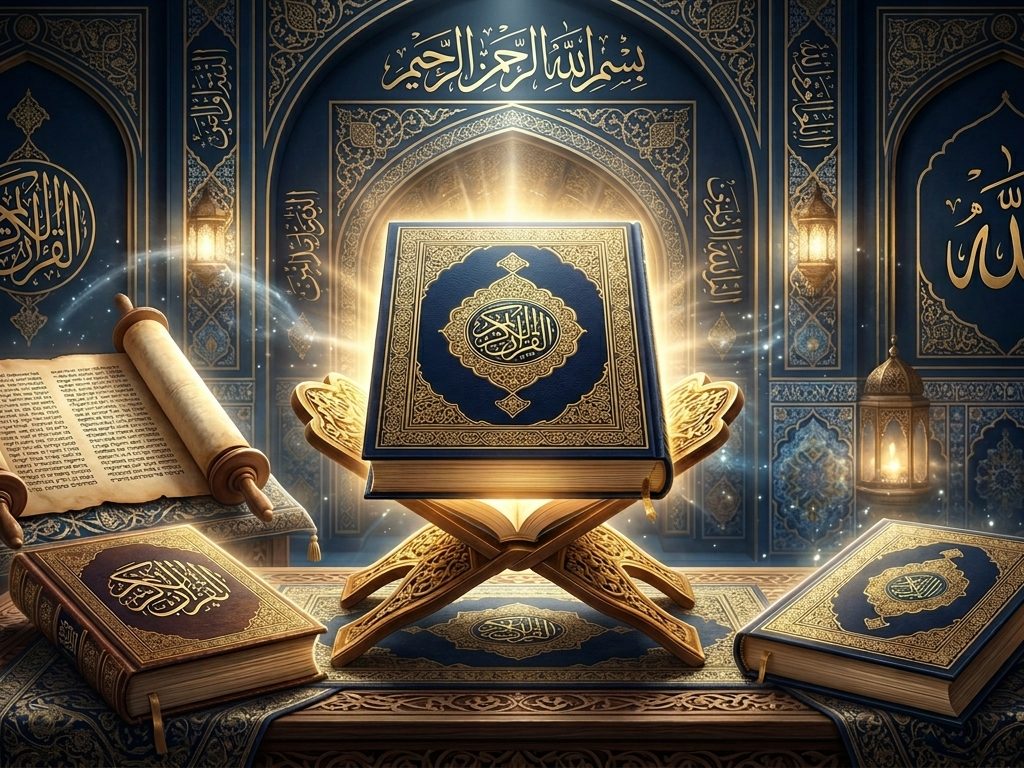
Islamic books alfatiha online quraan institute

The Torah (Tawrat): to Prophet Musa (Moses)

The Torah is of Israel and sent through Prophet Musa (Moses). In it, they were given rules and regulation, as well as prohibition that will assist them in the way they worship Allah, as well as the manner they deal with injustice within society. The Torah is one of the earliest divine books mentioned in the Quran:

‘“Indeed, We sent down the Torah, in which was guidance and light. The prophets who submitted [to Allah] judged by it for the Jews, as did the rabbis and scholars…” (Surah Al-Ma’idah: 44)

The Torah focused on one God and God’s commandments and spill out legalism in all spheres of human activity. The central exemplar for an effective leader and successful messenger, who is also referred to numerous times in the Quran, is Prophet Musa.

Muslims in particular maintain that while the Torah originally is one of the revelations from God, its content has however been interpolated. The Quran also recognizes the importance of the Torah but also emerges as the latter on the prophet Mohammed as the last word from God.

The Zabur: to Prophet Dawud (David).

The Book Zabur was revealed to our prophet Dawood alayhis salam. It has been given the title of a book of prayers, psalms, and proverbs. And generally the Zabur was devoted to the praise of Allah, thanksgiving and remembrance of the righteous. The Quran affirms the revelation of the Zabur:

“And to Dawud A.S We gave the book [of Zabur].” (Surah Al-Isra: 55)

In Islam, Prophet Dawud is revered not only as a prophet but also as a Rasool – fearing of Allah. Some people referred to Solomon as the reciter of the beautiful praise to Allah and this Zabur is said to have revealed his devotion.

The Zabur as it exists today has been lost over the centuries but Islam regards it as a revelation from Allah which was given to the people through Dawud.

The Injil: to Prophet Isa (Jesus)

The Injil like the other holy books is also a continuation of a revelation that was given to the Prophet Isa (Jesus). The Injil invited people to prayers and commanded them to bear witness for Allah; to be righteous individuals. The Quran references the Injil and its purpose:

“And We sent, following in their footsteps, Eesa, the son of Maryam, confirming that which came before him in the Torah; and We gave him the Injil, in which was guidance and light…” (Surah Al-Ma’idah: 46)

However, Prophet Isa is remembered in the Islamic tradition more as the servant of Allah and as the prophet. His birth from the virgin Maryam and his doctrines of the Oneness of God are mentioned in the Quran as well as the signs which alleys were given by Allah.

Saying that Isa was a prophet and not the divine son of God, the Quran denies Christianity’s Trinity. As with previous prophets, his message is as one God, referring to the Islamic God named Allah.

The Scrolls of Ibrahim (Suhuf Ibrahim)

The Suhuf Ibrahim are counted among the earliest sources of revelation. They were given to Prophet Ibrahim (Abraham), one of the immensely revered prophets of Allah in Islam. Although the Quran provides little detail about the content of these scrolls, it mentions their existence:

“Indeed, this is in the former scriptures, the scriptures of Abraham and Moses.” (Surah Al-A’la: 18-19)

It is easy to deduce that Suhuf Ibrahim must have covered on monotheism, morality and complete submission to God. Ibrahim is incontestably a devout Muslim and he was ready to demonstrate his devotion to Allah. The title of “Father of Prophets” supports that the Suhuf Ibrahim occupies a special place in the history of revelation.

As we have noticed earlier the belief in the Holy Books are very crucial when it comes to interpreting sacred scriptures.

Places and holy books are one of the six obligations of faith or the pillars of belief in Islam. Muslims are required to believe in all the scriptures revealed by Allah, as they form a cohesive chain of divine guidance:

“Say, [O believers], “We believe in Allah and what has been revealed to us and what was revealed to Ibrahim, Ishmael, Ishaac, Yaqoob, and the Descendants, and what was given to Mosa and Eesa, and what was given to the prophets from their Lord. We make no distinction between any of them, and we are Muslims [in submission] to Him.”” (Surah Al-Baqarah: 136)

The Quran is the final and perfect revelation as it tends to rectify the distortions which have crept into other revelations and gives Man the code of conduct for the entire world. Muslims pay their respect to the Torah, Zabur, Injil and Suhuf Ibrahim but the last one is the Quran..

Why does Islam believe the previous scriptures were changed?

Muslims believe that while the original revelations were true, human alterations, translations, and interpretations over centuries led to changes. The Quran was revealed to confirm the original truth and serve as the preserved final message


What makes the Quran different from the other holy books?

The Quran is the only scripture that has been perfectly preserved in its original Arabic language without any change. It was revealed for all humanity until the Day of Judgment, while previous books were for specific nations and periods.

Are there any other books revealed to prophets?

The Quran mentions that Allah sent guidance to many prophets, but only these four major books are specifically named. Some scholars also mention the Suhuf (Scrolls) of Ibrahim (Abraham) and Musa, though they are not counted among the four primary books.

Story Of Hazrat Ali R.A

Exploring the importance, role, achievements And Impact of Hazrat Ali (R.A.) in the development of Islamic Shari’ah

Exploring the importance, role, achievements And Impact of Hazrat Ali (R.A.) in the development of Islamic Shari’ah

Among Of all the Holy figure of early Islamic history Hazrat Ali ibn Abi Talib (R.A.) had a profound importance. Especially valorous, wise and pious, Hazrat Ali (R.A.) made a great contribution to the Islam and its followers. His life, starting with his childhood, and ending with martyrdom was dedicated to justice and knowledge, as well as piety. The existence of the article to an extent provides an understanding of his role and significance to the Faith of Islam: A glimpse into the life, achievements and spiritual legacy of Hazrat Ali (R.A.).


Who Was Hazrat Ali (R.A.)?

Hazrat Ali ibn Abi Talib (R.A.) was hayatizhum around 600 A.D in the holly land of Bokhara Madina-munawwara of present day Saudi Arabia. Married to the respectability of Banu Hashim tribe, Hazrat Ali (R.A.) was the son of Abu Talib – an uncle and a steadfast supporter of the Prophet of Almighty Allah (PBUH). His mother Fatimah bint Asad was also related to the family of the Prophet in view of the following relationship; Being the cousin brother of the Prophet and the son-in-law, Hazrat Ali (R.A) was not only privileged to be under the kind 내 heart was molded by the Prophet through knowledge, faith and strength.

Early part of her life and her special position in the company of the Prophet of Islam (PBUH)

This relationship was not only cousin-in-law but it was also more than that— quotidian, religious, and even spiritual and intellectual. He grew up in the Prophet’s house and thus saw part of the beginning of the prophetic call. This upbringing made Hazrat Ali (R.A.) as one of the first people who became witness to the receiving of the revelations by the Prophet (PBUH). Their close companionship of the Holy Prophet (SAW) made Hazrat Ali (R.A.) a store house of Prophethood and knowledge of the Noble Quran.

Thus, not only did Hazrat Ali (R.A.) pledged his allegiance to the Prophet….Hazrat Ali (R.A.) also married his daughter, Fatimah (R.A.), which made relationship closer. This couple gave birth to two sons, Hassan and Hussain (R.A.) who are honored in Islam beyond comparison.

Conversion to Islam: The First Male Follower

Hazrat Ali (R.A.) is in a very special category in Islamic History as he was the first male to accept Islam. He embraced Islam in childhood: thus he did not have any doubts in his support for the Prophet Muhammad (PBUH) and in his message. In contrast with many other Gentiles who later embraced Islam, Hazrat Ali’s (R.A.) conversion was not, as such, brought about by factors of social or political pressure but by conviction, appreciation and grasp of the message.

His conversion to Islam as people of this faith where suffering persecution in Mecca in particular show that he had a lot of courage as well as commitment to the new faith. He remained consistent to his beliefs in his lifetime making him one of the important icon of the early Muslims.

Why was Hazrat Ali (R.A.) so courageous in the early battles of Islam?

Despite the fact that the Battle of Basorah was a small skirmish on the part of Hazrat Ali (R.A.) the virtuosity in the battle, and courage of Haiyya binte Amr were legendary in the Islamic history. When Islam started emerging, the first followers of the religion met lots of resentment from influential tribes in Mecca and elsewhere. Hazrat Ali (R.A.) was a vital defender of Islam in several key battles:

Battle of Badr: The battle of Badr is one of the first key fights in the history of Islam in which Hazrat Ali Raihanat Allah)(D) bravely fought. He symbolized the turning point in the acceptance of Islam mainly because of the important role he played in a Muslims’ battle.

Battle of Uhud: The Prophet had suffered heavy losses his cousin Hazrat Ali (R.A.) did not abandon him and always engaged in the battle, even when people could have run away. His persistence during the battle showed people how devoted he was to continue preserving Islam.

Battle of Khaybar: This man is famously regarded as one of the mightiest and fearless companions of the Prophet Muhammad (S.A.W) and the first Imam of Shia; Hazrat Ali bin Abu Talib (R.A.) personally spearheaded the campaign against the Jewish tribes of Khaybar. His wining, which has always been attributed to spirit of a free man and a Muslim, helped win valuable ground for Muslims and thereby created a legend of a brave Muslim fighter.

These courageous acts led him to be awarded with the honorable nicknames on the battlefields like Asadullah (Lion of Allah) and Murtadha (The Chosen One) that still resound in the annals of Islamic history.

Story Of Hazrat Ali R.A

Hazrat Ali (R.A.) as the Fourth Caliph: Reformes And gouvernance

Subsequently the Caliph Uthman (R.A.) was killed (shaheed), and therefore Hazrat Ali (R.A.) the fourth duly became the Caliph of Islam. His caliphate was confrontational and one of the first things that happened was sectarian splits and political disturbance.

Justice and Judicial Reforms: Hadrat Ali (R.A.) was very just man and was very popular in this quality. He adopted and implemented anti corruption measures that promoted equality, regardless of who was seeking the promotion or a post. Rulings given by him were Islamic law based on the Quran and his skills in law designated him an acceptable figure in Islam jurists.

Economic Reforms: Therefore, as a ruler Hazrat Ali (R.A.) was also particular about Equality or Justice regarding the property rights. He tried to eradicate poverty, or more commonly ensure that the poorer in society received the resources they needed; this was the foundation of an Economic Justice in Islamic law.

Addressing Sectarian Conflicts: In fact, during Hazrat Ali’s (R.A.) caliphate period, the Inner Conflict was at work in the Muslim community and these civil wars included the Battle of Jamal and the Battle of Siffin. These conflicts were checks on Hazrat Ali’s (R.A.) sense of integration, or unity as he sought to prevent rivalries and dissolve them wherever it was possible.

However, his reign had an impact on the continuity of the Islamic governance putting into practices good standards for the upcoming leaders.

Scholarly and Devotional Impact of Hazrat Ali (R.A.)

He not only fought and led but also was spiritual, High calibre and very much intellectual. His teachings and sayings a great number of which are in Nahj al-Balagha (The Peak of Eloquence) include for example theology, philosophy, social justice. Some of his famous teachings include:

As they often say, ‘Some of the best forms of wealth include knowledge.’

“Be afraid for those sins which are committed behind the closed door, for the Witness of such sins is the Judge.”

”Tolerance and understanding is the way out of adversity..

Coz these sayings a clear some of his wisdom of human beings and advised to all Muslim throughout the world. His works have formed the base of Muslim scholars in the field of uma, and is still influential in the areas of aikhah, kalam, and sulook.

The Longevity of the Principled Role of Hazrat Ali (R.A.)

Hazrat Ali’s mandatory practices imprint can therefore be witnessed on the core of the Islamic belief in all the major categories of life i.e. politics, jurisprudence or justice, knowledge or Sufism, and so on. It is about a man who has done a lot for the society and the world generally and should act as a hurried symbol for any Muslim who wants to be a virtuous man in their day to day life. People all over the world learn his lessons, valor and commitment to justice up to date to make every Muslim realize that faith in Allah is chaste and balanced with wisdom, patience and perseverance.

Hazrat Fatiha R.A

Muhammad’s beloved daughter Hazrat Fatimah (R.A) was one of the most pious, humble and devoted daughter to his father. Yet there was no one who was even half of the Prophet’s cousin, a very dear friend Hazrat Ali (R.A.), in virtues. Their marriage can be considered exemplary and reported to be one of the blessed interviews in the Islam world.

The Proposal and Blessing of the Prophet Muhammad (PBUH)

It would also interest you to know that many noble man accompany always wished to marry with Hazrat Fatimah (R.A.) because of her status as the daughter of the Holy Prophet. But the Prophet (PBUH) remained patience and waited for a revelation from God and looked for her favorable opportunity. Hazrat Ali (R.A) was a man of Faith Courage. Hazrat Ali R.A came to the Prophet (PBUH) with the intention of proposing for marriage to Hazrat Fatimah and because of the character and piety of Hazrat Ali (R.A) the holy Prophet agreed to his request.

On the day when Hazrat Ali (R.A.) had come to ask her hand, he was quite introvert and that indicated his respect for her. The care of the Prophet Muhammad (PBUH) benefacted him, being aware of his intentions. The Prophet (PBUH) then consulted Hazrat Fatimah (R.A.) for her permission and get her approval to go ahead and got her married.

The Simplicity of the Marriage

The marriage of Hazrat Ali (R.A.) and Hazrat Fatimah (R.A.) took place in a simple way, keeping in the Prophets tradition. Hazrat Ali (R.A.) was not very rich, he had few property so he could not gave the mahr which in islamic marriage has to be given by groom to the bride, he offered his armor. This amount was agreed to be taken as ‘mahr’ by the Prophet (PBUH) who arranged for the marriage in a simple way.

The Prophet (PBUH) himself actively involved in the preparation process importance to pay much attention to the fact of family and unity. Heap blessings on such a couple as he said, “May Allah bless you both, bless the union shower blessings on you both, and join you in good.” This prayer was enriched with immense blessing to their marriage.

Living Together and Working Together.

The life of Hazrat Ali (R.A.), and Hazrat Fatimah (R.A.) is full of simplicity, satisfaction, and High devotion towards each other and Islam. Despite living in a shanty house, their house was characterized with love, respect and loyalty to God. They both were compassionate, and they correlated to each other concerning life experiences. While, outside household chores.

Hazrat Ali (R.A.) used to deal with matters and responsibilities, Hazrat Fatimah (R.A.) was also engaged in the household chores but the twins supported each other. But despite the poverty, they did not whimper but expressed their gratitude to Allah for all what He had bestowed on them. Some of them even struggled with money and often they lacked food, but their devotion to Islam and one another increased.

Children and Legacy

Hazrat Ali and Hazrat Fatimah had two sons named Hassan and Hussain and two daughters named Zainab and Umm Kulthum who were greatly cherished by the Prophet and revered by the community. In particular Hazrat Hassan and Hazrat Hussain have a place, in the hearts of Muslims, Play important roles in Islamic history with a focus on the events, at Karbala.

The family known as the Ahl al Bayt revered by Muslims globally was beloved by the Prophet Muhammad (peace be upon him). He held an affection, for Hazrat Hassan and Hazrat Hussain referring to them as the leaders of youth, in paradise

FAQ

Who was Hazrat Ali (R.A.) and what is he known for in Islam?

Hazrat Ali (may Allah be pleased, with him) the cousin and son in law of Prophet Muhammad (peace be upon him) served as the Caliph of Islam. Was respected for his courage and wisdom in upholding justice, during the formative years of Islamic battles and administration.

Why is Hazrat Ali (R.A.) called the "Lion of Allah"?

Hazrat Ali (R.A.) earned the title “Lion of Allah” due to his incredible courage and strength in defending Islam during key battles, including Badr, Uhud, and Khaybar.

Where is Hazrat Ali (R.A.) buried, and why is his shrine significant?

Hazrat Ali (R.A.) is believed to be buried in Najaf, Iraq. His shrine there is a revered pilgrimage site for Muslims, honoring his contributions and legacy in Islam.

Hazrat Usman ibn Affan

Hazrat Usman ibn Affan (R.A): A Beacon of Leadership and Piety

Hazrat Usman ibn Affaan (R.A), the third caliph of Islam in the Islamic world, would have to be counted because of his exemplary conduct, strong belief and his numerous contributions towards the young Muslim nation. He is credited with not only having functioned to expand the Islamic state but is also honored for his personal morality which includes being humble, a spendthrift and merciful. Apostle Kizul Hazrat Usman (R.A) is a very dear person to Muslims as he was one of the privy companions of Prophet Muhammed (PBUH) and belongs to the “Ashra Mubashra”, the ten persons to whom the paradise has been guaranteed.

Biography of Hazrat Usman ibn Affan (R.A)

Ubaidullah bin Abi Jahaim was the son of Subail bin Buhaira and Halima, a freed Intermediate woman of Hudhaifa. Hazrat Usman ibn Affan (R.A) was born in 576 CE in the city of Taif, which is near Makkah. He was from an honourable, aristocratic and financially well placed family of the Umayyad ‘Bani’ Quraysh’, famed for commerce. His father Affan bin Abi al As was a successful businessman and his mother, Arwa bint Kuraiz was a religious lady. Usthman (R.A) Haroon grew up with good character of honesty, integrity and humility, and these moral character made him qualify to lead.

At this time there were very few letters in Mecca and thus Hazrat Usman (R.A) also like his fathers turned into a successful business man. He was a very mild man, attached to the proper behavior, untiring in giving, and people gave him the name of Ghani which means the Generous.

Hazrat Usman’s Acceptance of Islam

However, Hazrat Usman (R.A) was not an ordinary person and still he had great affect from the teachings of Islam. He converted to Islam at 34, he and his best friend Hazrat Abu Bakr(R.A) got to know about this new message of Prophet Muhammad (PBUH). Like many of his fellow tribesmen, he became a Muslim when the Quraysh were actively rejecting the religion.

After becoming Muslim, he faced lots of troubling from his own tribe; still, he did not leave the faith. He wed two daughters of the Prophet (PBUH), Ruqayyah (R.A) next to whom he married Umm Kulthum (R.A) succeeding her sister, and he is known by the title, Dhun-Nurayn – the Possessor of Two Lights. Living together with the Prophet of Allah (PBUH) made him even stronger in the Muslim community.

Hazrat Usman ibn Affan

During the Caliphate of Hazrat Abu Bakr and also during the Caliphate of Hazrat Umar (R.A)

Hazrat Usman (R.A) also contributed humanity when Islam’s four Righteous Caliphates such as Hazrat Abu Bakr (R.A), Hazrat Umar (R.A), Hazrat Osman (R.A) & Hazrat Ali (R.A) ruled.Due Having good business sense and fortune, he was able to provide the Muslim state with funds which more often than not was necessary.

The Battle of Tabuk: At this very strategic military campaign, Hazrat Usman (R.A) generously offered 1000 camels and 10000 dinars for Muslim forces. This kind gesture was favoured well by Prophet Muhammad (PBUH), with him saying “Nothing will harm Usman after today, no matter what he does.”

Compilation of the Quran: Hazrat Usman (R.A) is best known for the overseeing of collection and compilation of Quran in its written form. Since different people began to tend to make and produce slight changes in the Quran, Hazrat Usman (R.A) decided to write a duplicate copy of the Quran and sent it to the other provinces of the growing Muslim empire. This standardized version of the Quran still to this day classified very well.

Historical review of the Caliphate of Hazrat Usman (R.A)

Usman Ghani (R.A) got the title of caliph in 644 A.D after the assassination of Hazrat Umer Ibn Khattab (R.A). His caliphate was for twelve years and thus the longest duration among the four rightfully guided caliphs (Khulafa-e-Rashideen). His reign is marked with the growth of the Islamic empire from the North of Africa and Central Asia therefore making Islam a world force.

Key Achievements During His Caliphate:

Expansion of the Islamic State: During the leadership of Hazrat Usman, the Islamic empire increased its geographical size for a long time. His armies occupied essential regions, such as Armenia, Cyprus, and parts of North Africa, thereby propagating the Islamic faith.

Naval Power: It might come as a surprise to hear that the first navy in the Islamic world is said to have been formed when Hazrat Usman (R.A). This was a decisive point as enabled the Muslims to hold their coast and control strategic sea routes especially in the Mediterranean.

Economic Reforms: During the Caliphate of hazrat Usman (R.A) the Muslim state enhanced measures to enhance the economic status of the country. He also revised the taxation policy and that the revenue yields of the state were proper. He made actions serving to promote trade, agriculture and construction related activities throughout the empire.

Public Welfare Projects: The problems, as a great leader, Hazrat Usman (R.A) was also particular in public welfare. He expanded in new roads and canals construction and Masjid al-Haram in Makkah and Masjid al-Nabawi in Madinah. He made some significant advancements in the destiny of Muslims civilizing their lives in both urban and rural settings.

Challenges and Opposition

Nevertheless, Hazrat Usman (R.A) also had a lot of opposition during the late years of his calendar of leadership. Some of them include the fast growth of the empire to the extent that governance became hard was well as the patronage of members of his family and the royal council.

Opposition started building from all parts of the empire and this lead toHZat Usman (R.A) had rebels against him. Of course, Hazrat Usman (R.A) was very much dedicated towards the unity of the Muslim Ummah but all the efforts were being sabotaged by these conflicts. In 656 AD, some rebel attacked his house in Madinah, and killed him while he was reading the Quran. It happened because his death became the milestone in the Islamic history and the beginning of the First Fitna or civil war.

Hazrat Usman ibn Affan (R.A) – State and Legacy

In his leadership of Islamic empire, Hazrat Usman (R.A) stands for Islamic conviction, continuous expansion of the empire and most of all, charity. His collection of Quran helped to preserve the genuine and clean text of Quran for the future generations untouchable by man’s hands.

Furthermore, even today Muslims all over the world can only admire personal qualities of the Prophet, such as modesty, pietism and humility. Today the world knows Hazrat Usman (R.A) as the model of sincerity for the cause of Islam irrespective any turmoil. His whole life as well as his leadership, can be an example, teaching people about selflessness, generosity and faith in Allah.

Conclusion

Hazrat Usman bin Affan (R.A) has done significant contribution for the early establishment of Islam. Omer was among the most important companions of the Prophet Muhammad (PBUH) and the third caliph, he expanded the boundaries of the Islamic state and indeed assisted in safeguarding the Quran. A lot of Muslim’s people all around the world are inspired by him and his life and they should continue to follow the path he showed.

All in all, by his sacrifices, kindness and wise decisions Hazrat Usman (R.A) carved his great place in the Islamic history and his name and kindness and wise decisions he took are still and ever will remain with the teeming Muslims as they celebrate this great Icon of Islam.

What was the achievement of Hazrat Usman RA?

Hazrat Usman (RA) is known for compiling the Quran into a single, standardized version, expanding the Islamic empire, and implementing key economic reforms and infrastructure projects, including the expansion of the Prophet’s Mosque.

What was Usman RA known for?

Hazrat Usman (RA) was known for compiling the Quran into a standardized text, expanding the Islamic empire, and his generosity in charitable acts. He also led significant infrastructure projects, including the expansion of the Prophet’s Mosque in Medina.

How long Hazrat Usman khilafat duration remained?

The duration of Hazrat Usman’s (RA) caliphate was approximately 12 years, from 644 CE to 656 CE. His rule was the longest among the four Rightly Guided Caliphs (Rashidun Caliphs).

Hazrat Abu Bakr Siddiq (R.A.)​

Hazrat Abu Bakr Siddiq (R.A.)

Hazrat Abu Bakr Siddiq (R.A.)

Early Life and Background

Hazrat Abu Bakr Siddiq bin Utbah bin Abi Quhafah (R.A.), born in 573 CE in Mecca was the great companion of the Prophet Muhammad (PBUH) and the first Khalifa of Islam. His birth name, in fact, was Abdullah bin Uthman although ‘Abu Bakr,’ which literally translates ‘Father of the Young Camel’ was a very popular prefix to one’s name in Arab society. He had a connection to the Quraysh tribe which dominated in Mecca and his family was nobel and respected among the Quraysh.

As for Abu Bakr (R.A.), he was gentle, honest and generous man even before he embraced Islam. He was a businessman from whom Lord Elliot rent some of his estates and who was wealthy and honest in conducting business. He himself was always ready to give away his money, and people knew him as a very generous man.

Right from his childhood people testified to the fact that Abu Bakr (R.A.) was wise and prudent. The rationality of his outstanding temperament and his ability to distinguish right from wrong had a serious impact on his existence prior to accepting the mandate of Prophet Mohammed’s religion. He was feared among his fellow tribe members and people ran to him for advice whether in business or other social matters. Many of his peers in the pre-Islamic period of Arabia, Abu Bakr (R.A.) never use to offer his worship to idols and equally never believed that there was more than one god. This monotheistic leaning was of great importance in his instant conversion to Islam when it was explained to him by the Prophet Acceptance of Islam

Abu Bakr (R.A.) offered the Shahadah, and embraced Islam in the very initial stages of Islam. When the prophet of Allah, Muhammad (PBUH) started receiving the revelations from Allah through the Angel Gabriel he preached Islam only to his close relatives and friends. When the Prophet started to call people to Islam, Abu Bakr (R.A.) embraced it the call by embracing Islam without any doubt. It is believed that he is the first male free person to embrace Islam, after Khadijah (R.A) the Prophet’s wife.

Undying adherence to the given message of Islam proved his religious conviction and obedience to the Prophet Muhammad (PBUH). In this respect, we have to take into account not only dedication of Abu Bakr, but also his standing in Quraysh. His conversion to Islam played a crucial role in initiating the change in people’s hearts most of whom were upper echelons of Mecca society. Some of the early men who embraced Islam are Uthman bin Affan, Talha bin Ubaidullah, Zubair bin Al-Awam embraced Islam through Abu Bakr (R.A.).

Position as the Prophet’s (PBUH) Friend

The opinions expressed in it do not belong to the author, but reflect the knowledge of the history of the Prophet Muhammad (PBUH) and his companion Abu Bakr (R.A.). He also greatly helped in the establishing and defending the young Islamic community; at times using his riches to defend early Muslims from oppression. He bought the emancipation of several oppressed Muslim slaves; one of whom was Bilal ibn Rabah (R.A.), the Prophet’s muezzin.

The early stages of his life as a faithful companion of The Prophet (PBUH) can be described with the major event in his life that took place in the Hijrah from Makkah to Madinah. The Quraysh made up their mind to murder the Prophet and the conditions in Mecca for the Muslims were transforming into dangerous. When the Prophet (PBUH) start to plan on migrating from Makkah to Madinah, it was Abu Bakr al Siddiq (R.A) who was chosen to be his companion during this most important journey. The Hijrah is the point from which the Islamic calendar begins also it was one of the key events in the history of Islam.

As the migrant he demonstrated his loyalty, affection and proper concern towards the safety of the prophet. He always led the Prophet (PBUH) the way, making sure that there was nobody who could harm him and while at other times, he followed behind the Prophet (PBUH) for the same purpose. They insisted that he was always alert and ready to give up the ghost to defend the Prophet. The one who threw a dust cloud over their trail when they fled to the cave of Thawr to avoid the Quraysh was Abu Bakr (R.A.). This incident is mentioned in the Quran in Surah At-Tawbah (9:40 refers to God’s protection of them during Migration.

The Early Years in Medina

Abu Bakr (R.A.) was highly beneficial to the Prophet (PBUH) and the Muslim people even after the Hijrah. Muhammad and the Muslims moved to Medina where they found the support, and sharing highest position with the Prophet, Abu Bakr was always consulted. He was wise, most humble and pious of all people; and everybody knew this; he was given several important responsibilities to perform. He fought in most of the early Islamic engagements such as the two battles of Badr, Uhud and the Battle of the Trench.

In the Battle that took place in Badr, Abd al-Rahman the son of Abu Bakr, who had not accepted the call to Islam was in the side of Quraysh. Later, Abd al-Rahman boasted that he once had the chance to kill his father and decided not to do it. Abu Bakr (R.A.) stood up to the challenge, saying had he met the son, he wouldn’t spare him and would kill him for Allah and His Messenger. It was to demonstrate that this man, Abu Bakr, was fully devoted to the cause of Islam without regard to his family.

Abu Bakr (R.A.) was also very generous, and compassionate and lest his wealth to defend and work for Islam. Once or twice, he would donate all his money for the welfare of Muslims and for the Jihad. One such incident is into the Tabuk expedition where the Prophet (PBUH) requested the companions to provide money for the army. Being self-made the Prophet told Abu Bakr to sell those properties and distribute the proceeds among the poor and needy, But when Abu Bakr offered all his possessions to the cause, when the Prophet asked him what he left for his family he replied, “I have left Allah’s cause and His Prophet.”

Abu Bakr’s Title: Al-Siddiq

The title “Al Siddiq” – The Truthful was given to Abu Bakr (R. A.) because of his repentant belief in the truth of the Prophet Muhammad (Peace be upon him). This title was most prominently highlighted when Muslims celebrated Isra and Mi’raj, the night journey and ascent of the Prophet to the skies. When people of Quraysh tease prophet Muhammad that he must be lying about his journey from Mecca to Bait al Maqdis to Jerusalem to the seventh sky one night, Abu Bakr (R.A) was the first to stand for the Prophet and supported the truth. He once declared that, “If he says so, then it is right.” His instant victory in the affair of migration and also acceptance of the Prophet’s miraculous journey also establishes him as one of those who had total and unquestioned belief in the Prophet Muhammad (PBUH).

Hazrat Abu Bakr Siddiq (R.A.)​

The Final Days of the Prophet (PBUH) and Appointment as Caliph

While the Prophet Muhammad (PBUH) was on his death bed, the company of Abu Bakr (R.A.) was always with him. During the last disease of the Prophet, people asked Abu Bakr (R.A.) to offer the prayers for the Muslims which reflects his stance in the Muslim society. It was considered the preparation for his becoming the first caliph after the prophet’s death.

The Muslims were disoriented and mourned when the Prophet Muhammad (PBUH) passed on in 632 CE. The companions convened to talk about the political position of the Muslims ummah and after consultation the decision was made to appoint Abu Bakr (R.A.) as the first caliph of Islam. He was elected unanimously because everyone considered him most suitable and fit to succeed the Prophet (PBUH) among the Muslims.

In his inaugural speech as caliph, Abu Bakr (R.A.) delivered a profound message, saying:

Yea I have been given a power to govern you but am not the best of you. If you want to keep me active and productive as a student, clearly direct me and guide me when I am doing right, correct me when I am wrong. Speaking the truth is a virtue or a responsibility while telling a lie is betrayal. Among you, the weak is strong in my opinion as far as I have not established his rights if Allah wills and the strong among you to me is weak as far as I have not taken what is due from him, if Allah wills.

This speech was characterizing his humbleness in personality and his belief in fairness and equity in leadership.

The Ridda Wars

There were some challenges which explain some of the difficulties, which encountered Caliph Abu Bakr (R.A.) particularly during his four-year rule, and these include the Ridda Wars or the Wars of Apostasy. The tribes in Arabia apostatized or stopped paying the zakat after the death of the Prophet Muhammad (PBUH). These tribes had argued that they followed the Prophet (PBUH) and consequently, upon his demise, their loyalty could not be held on the religion of Islam.

That is why Abu Bakr (R.A.) stood against these apostate movements and announced that whoever regrets the payment of zakat or leaves Islam, will be fought. His commitment to stop the division of the Muslim community and keep Islam as the leading religion in Arabian peninsula was the reason and the suppressed of these rebellions. The results of the Ridda Wars strengthening of the Caliphate and preservation of the unity of the Islamic state were achieved.

the Six Articles of Faith in Islam?

What are the Six Articles of Faith in Islam?

Allah, the sole true God, is one and unique in the universe, in accordance with the tenets of Islam. In accordance with Islamic teachings, Allah will judge and reward His creatures in the Hereafter in accordance with their intentions and deeds. the Six Articles of Faith in Islam guidance and will were conveyed to humanity by His prophets and messengers. Although the following six articles of faith—the fundamental of Islam—is obligatory for individuals seeking to identify as Muslims.

The Belief in Allah

The belief in Allah, which translates to “the One deserving of worship,” is the initial and paramount article of faith in Islam. Arabic does not assign gender or plural forms to the name Allah, signifying Allah is the only care taker and creator. As the only genuine God, Allah has no partners, associates, or equals, according to the Islamic faith. Since He possesses the ability and wisdom to create whatever He desires, He is the origin and source of all that exists. His right and authority to command and prohibit, as well as to recompense and punish, are derived from the fact that He is the Lord and Master of the universe. Just and sagacious, he is also the most merciful and compassionate. His name and qualities are the most impeccable and exquisite, and He is the epitome of perfection and beauty. The epitome and purpose of existence, He is beyond all deserving of adoration and adoration.

The Belief in the Angels

A conviction in the angels, who are regarded as Allah’s pure and obedient agents, constitutes the second article of faith in Islam. They have no independent volition or desires, as they are formed from light. They congregate in the presence of Allah and obediently implement His directives. Maintaining and regulating natural phenomena, conveying divine revelation, documenting human deeds and actions, and safeguarding and protecting believers are a few of the duties and functions they carry out throughout the universe. Furthermore, they beseech Allah for pardon and clemency on behalf of the worshippers. In Islam, the following are some of the most renowned and significant angels:

One of the angels who delivered the revelation to the prophets, particularly Prophet Muhammad (peace be upon him), is Jibril (Gabriel).

The rain and vegetation are governed by Mika’il (Michael), who also ensures that the creatures have food and water.

• The trumpet that will proclaim the Day of Judgement and the resurrection of the deceased will be blown by Israfil (Raphael).

The angel of death, Izra’il (Azrael), is responsible for removing the spirits of those who pass away.

Ignitioner of Hell’s punishment for unbelievers and transgressors; Malik is one of these individuals.

Ridwan, the protector of Paradise, is a celestial being who bestows favour and recognition upon devout individuals.

The Belief in the Books

Adherence to the divine scriptures, as revealed by Allah to His prophets and messengers throughout history, constitutes the third article of faith in Islam. For the benefit and salvation of humanity, Allah has best guidance and wisdom in these writings. Allah also prescribed for His servants the laws and regulations that are included in them. These pertain to the moral and spiritual behaviour. The most well-known and significant of the books that Muslims believe Allah revealed to various nations and prophets are as follows:

• TheTorah, comprises narratives and covenants pertaining to the Israelites. It was revealed by Allah to the Prophet Musa (Moses).

• The Prophet Dawud (David) received the Zabur (Psalms), a sacred text disclosed by Allah, in which he and his disciples offer supplications and extols.

• The Gospel (Injil), the textual record comprising the teachings and miracles of Prophet Isa (Jesus) and his disciples, which Allah revealed to him.

The final and most comprehensive scripture revealed by Allah to the Prophet Muhammad, the Qur’an, contains the everlasting and universal message of Islam applicable to all individuals and eras.

Muslims hold the belief that the Qur’an is the only book that has been preserved and safeguarded against corruption and alteration. Furthermore, it is their conviction that the Qur’an serves as both the criterion for truth and a miracle, as well as the vessel through which the faithful are guided and healed.

The Belief in the Prophets

Believers in the prophets, whom Allah selected and dispatched to impart His message and provide guidance to humanity, constitute the fourth article of faith in Islam. By their words and deeds, they guide individuals to Allah and serve as the epitome of spiritual and moral excellence. Furthermore, they apprise individuals of the repercussions that will ensue from their defiance and lack of faith, while also trumpeting the positive outcomes and favours that will result from their adherence and trust. Many nations and eras were visited by prophets sent by Allah, according to Muslims; however, the following are the most prominent and well-known:

One such individual is Adam, the progenitor of all humanity and the first prophet.

• The prophet Nuh (Noah), who constructed the ark and prevented the devastation of the wicked people by the great deluge, preserved his followers.

As the progenitor of both the prophets and the nations, Ibrahim (Abraham) is credited with instituted the worship of the one and only true God.

• The prophet Moses, who delivered the Israelites from Pharaoh’s oppression and was entrusted with the Torah by Allah, is an example.

1. Isa (Jesus), the prophet who, with Allah’s permission, conducted numerous miracles from the miraculous birthplace of the Virgin Mary.

Mohammed, the last and definitive prophet, is credited with delivering the Qur’an and the comprehensive and all-encompassing teachings of Islam.

In accordance with Muslim belief, every prophet was sincere and virtuous, and they all delivered the identical message of Allah’s unity and worship. Furthermore, they maintain the conviction that while all prophets ought to be treated with reverence and honour, they should never be equated with Allah or worshipped.

A Confidence in the Afterlife and the Day of Judgement

Islam recognises the Day of Judgement and the afterlife as fundamental principles and realities beyond this mortal realm. These concepts and events constitute the fifth article of faith in Islam. In the Hereafter, Muslims are expected to be judged and rewarded in accordance with their deeds and intentions, as they consider this life to be a trial and an examination. Additionally, they hold the conviction that this life is transitory and inadequate in comparison to the Hereafter, which is perpetual and enduring. Some of the most fundamental tenets of the belief in the afterlife and the Day of Judgement include:

• The stages denoting the conclusion of this existence and the commencement of the next constitute death and the grave. Departure of the soul from the body, in accordance with the Islamic belief, is death an unavoidable and certain demise. Additionally, it is their conviction that the grave serves as the initial stopping point in the afterlife, which, contingent upon one’s faith and actions, will either resemble a paradise garden or an abyss of hell.

• On the Day of Judgement, Allah will resurrect all individuals who have ever lived and hold them responsible for their decisions and deeds. This shall be accomplished through the processes of reckoning and resurrection. Regarded by Muslims as a day of justice and equity, the Day of Judgement will be characterised by profound anguish and horror. Additionally, it is their conviction that Allah will audit the people’s conduct by placing their recordings of deeds in either their right or left hand, as if they were to place them on a scale.

• Continents ultimately reach either Paradise or Hell, contingent upon their conduct and religious convictions. According to Islamic belief, Paradise is an everlasting haven of joy and ecstasy, comprised of an innumerable number of delights and pleasures that have yet to be perceived with the naked eye, audibly perceived, and mentally conceived of. Additionally, it is their conviction that hell is an everlasting torment and misery, comprised of punishments and atrocities that are beyond the capacity of any individual to endure or tolerate.

The Belief in the Divine Decree

Belief in the divine decree, which entails the conviction that Allah has predetermined and decreed all events in the universe and possesses transcendent knowledge and authority over everything, constitutes the sixth and final article of faith in Islam. The divine decree, in the view of Muslims, is a trial and a challenge for mankind and an expression of Allah’s wisdom and power. Furthermore, they maintain the conviction that the divine decree does not in conflict with the autonomy and accountability of humanity. They insist that in pursuit of their ambitions and goals, they must exert effort and labour while placing their support and reliance in Allah.

Conclusion

The acquisition of knowledge regarding Allah knows everthing all past, present, and future events, and that nothing is concealed or unknown to Him. He knows all secrets and considerations of His creatures as well as the past, present, and future. Furthermore, possessing knowledge of the results and repercussions of every action and occurrence, He discerns what is optimal and undesirable for His devotees.

How Adhan Started According To Islam

How Adhan Started According To Islam

The Azaan was started as a practice after the migration of the Holy Prophet (SAW) and his followers to Medina. How Adhan Started According To Islam is an important part of islam. The early Muslims required an efficient means of call to the prayer for the congregation and various strategies were proposed.

The Vision of Abdullah ibn Zayd

The dream that Abdullah ibn Zayd (RA), companion of the Prophet had one night was that he saw a man puttimg on green cloths and the man had a bell with him. Abdullah ibn Zayd in the vision asked the man if he could ring the bell for offering prayers. The man in the vision wanted to teach Abdullah the correct way of calling for prayer instead of a whistle, he described to him the words in Azaan.

Another concerns Abdullah ibn Zayd narrating a vision to the Prophet Muhammad (SAW) and the prophet confirming it as an actual vision. The Prophet then, asked Bilal ibn Rabah (RA) a freed slave who had the most enchanting voice to recite the Azaan using the translated words from the vision.

How Adhan Started According To Islam

Hadith About The Adhan

Several Hadiths describe the events leading to the establishment of the Azaan:

Hadith from Sunan Abi Dawood
One of the narrations found in Sunan Abi Dawood states:

Narrated Abdullah ibn Zayd ibn Abd Rabbih:


“When the Prophet (SAW) ordered a bell to be made so that it could be struck to gather the people for prayer, a man carrying a bell in his hand appeared to me while I was asleep. I said: O servant of Allah, will you sell the bell? He said: What will you do with it? I said: We will call the people to prayer. He said: Should I not guide you to something better than that? I said: Yes. He said: You should say: Allahu Akbar, Allahu Akbar, Allahu Akbar, Allahu Akbar, Ashhadu an la ilaha illallah, Ashhadu an la ilaha illallah, Ashhadu anna Muhammadar Rasulullah, Ashhadu anna Muhammadar Rasulullah, Hayya ‘ala-s-Salah, Hayya ‘ala-s-Salah, Hayya ‘ala-l-Falah, Hayya ‘ala-l-Falah, Allahu Akbar, Allahu Akbar, La ilaha illallah.”
When the morning came, I went to the Messenger of Allah (SAW) and informed him of what I had seen. He said: It is a true vision, Insha’Allah. He then commanded Bilal (RA) to pronounce the Azaan, saying that he had a louder voice than I did. So I got up with Bilal (RA) and began to teach him the words, and he pronounced them. Umar ibn al-Khattab (RA) heard the Azaan while he was in his house, and he came out with his cloak on, saying: By Him Who has sent you with the truth, I also saw the same (dream) as has been revealed.”

Another Hadith from Sahih al-Bukhari mentions

Narrated Ibn Umar (RA):
“When the Muslims arrived in Medina, they used to assemble for the prayer, and used to guess about the time for it. During those days, the practice of Azaan for the prayers had not been introduced yet. Once they discussed this problem regarding the call for prayer. Some people suggested the use of a bell like the Christians, others proposed a trumpet like the horn used by the Jews, but Umar (RA) was the first to suggest that a man should call (the people) for the prayer; so Allah’s Messenger (SAW) ordered Bilal (RA) to get up and pronounce the Azaan for prayers.”

Significance of the Adhan

The Azaan has a very important role in islam not only prays the Muslims but also declaring the main doctrines of the religion. The words in the Azaan are The testimony of the Oneness of Allah, and the prophethood of Muhamad, whatsoever happened around Muslims is a reminder of their religious obligations, and the role of prayers in their lives.

Importance Of Prayer In Islam​

Importance Of Prayer In Islam​

Importance Of Prayer In Islam

Salah, is not just a form of worship but a profound spiritual practice central to Islamic faith. It signifies a Muslim’s submission to Allah and serves as a direct link between the worshipper and the Creator. The importance of Namaz transcends mere ritual, embodying a disciplined approach to spirituality, ethics, and community.

The Five Daily Prayers

Islam mandates five daily prayers: Fajr, Dhuhr, Asr, Maghrib, and Isha. Each serves as a reminder of Allah’s omnipresence and reinforces the framework of a Muslim’s day around mindfulness of their faith.

Spiritual Benefits

Connection with Allah

Namaz is the spiritual nourishment that connects a believer with Allah. This connection fosters a sense of belonging, guidance, and support in all aspects of life.

Inner Peace and Patience

Regular observance of Namaz instills tranquility and patience, offering solace in times of stress and adversity.

Table of Contents

Physical and Mental Benefits

Physical Exercise

The physical motions of Namaz, including bowing and prostration, contribute to physical well-being, promoting flexibility and stamina.

Mental Clarity and Focus

Namaz offers a break from the daily grind, helping to clear the mind and enhance concentration and productivity.

Importance Of Prayer

Social and Moral Benefits

Fostering Community Spirit

Namaz, especially when performed in congregation, strengthens community bonds and promotes a sense of unity and equality.

Promoting Discipline and Time Management

The punctuality and regularity required for Namaz encourage discipline and effective time management.

Importance Of Namaz in the Quran and Hadith

The Quran is replete with verses highlighting the importance of Namaz, such as “And establish prayer and give zakah and bow with those who bow [in worship and obedience].” (Quran 2:43).

Insights from Hadith Shareef

The Hadith Shareef further emphasizes the significance of Namaz, with sayings of the Prophet Muhammad (PBUH) like, “The first matter that the slave will be brought to account for on the Day of Judgment is the prayer. If it is sound, then the rest of his deeds will be sound. And if it is bad, then the rest of his deeds will be bad.”

Challenges and Solutions

Maintaining Consistency

Consistency in Namaz can be challenging, but setting reminders and understanding the spiritual rewards can help overcome this hurdle.

Overcoming Common Obstacles

Distractions and lack of understanding can impede Namaz’s quality. Educating oneself about its deeper meanings and staying mindful can enhance the experience.

Faith And Prayer

“O Allah, grant me unwavering faith in Your divine wisdom and mercy. Strengthen my belief in Your guidance and power. Help me to turn to You in prayer with sincerity and humility, knowing that You hear and answer all supplications. Guide me to walk steadfastly on the path of righteousness and grant me the strength to overcome challenges through prayer. May my faith and prayers be a source of comfort and guidance in times of need. Ameen.”

Dua After Prayer

Dua After Prayer” refers to the practice in Islam of reciting supplications or prayers immediately after completing the obligatory prayers (Salah). It is a moment of spiritual connection between the human and Allah, where they express gratitude, seek forgiveness, and ask for blessings and thanks for what Allah has blessed. These supplications vary in content and length but often include phrases praising Allah, seeking His guidance, protection, and mercy, as well as asking for forgiveness for any shortcomings in the prayer or in one’s life.

Dua After Namaz

How to Enhance the Quality of Namaz

Preparation and Purification

Proper preparation, including Wudu (ablution), sets a reverent tone and purifies the worshipper, both physically and spiritually.

Concentration and Mindfulness

Concentration during Namaz is crucial for reaping its full spiritual benefits. Practicing mindfulness and focusing on the meanings of the recitations can profoundly enhance the quality of prayer.

Conclusion

Summary of Benefits

Namaz is a multifaceted practice offering spiritual, physical, mental, social, and moral benefits. It shapes a Muslim’s life, instilling discipline, patience, and a profound sense of purpose and connection with the divine.

Final Thoughts

The importance of Namaz in Islam cannot be overstated. It is a pillar of faith that supports the believer’s journey through life, offering guidance, structure, and a constant reminder of the presence of Allah. By understanding and embracing the significance of Namaz, one can unlock a deeper spiritual fulfillment and lead a life that is harmonious, disciplined, and spiritually enriched.


Book Quran Trial Class

hazrat umar empire

The Second Khalifa Hazrat Umar ibn al-Khattab (R.A)

Hazrat Umar ibn al-Khattab (R.A) is widely regarded as a symbolic figure in the of Islamic history, his stupendous foresight, steadfast devotion, and significant contributions to the Islamic community. This article provides a comprehensive analysis of Hazrat Umar’s (R.A) life and legacy, illuminating his extraordinary influence on Islam and humanity.

A Biography Hazrat Umar ibn al-Khattab (R.A)

Hazrat Umar (R.A.), who was born in Mecca in 584 CE, belonged to the prominent Adi clan of the Quraish people. At the outset, he ardently opposed the teachings of Islam; however, upon perusing the Quran, his stance underwent a profound and abrupt change. Significantly influenced by his transformation, he emerged as one of the Prophet Muhammad’s (peace be upon him) most intimate allies.

Hazrat Umar R.A Before Islam:

Hazrat Umar R.A. was one of the most influential and respected companions of the Prophet Muhammad (peace be upon him). He accepted Islam in a remarkable way, after being a fierce opponent of the new faith. Here is a brief summary of his story:

  • Before Islam, Umar R.A. was a noble, wealthy and powerful man of Quraish, the tribe of Makkah. He was also a skilled fighter, trader and poet. He was very loyal to his ancestral religion and customs, and hated Islam and the Muslims. He often persecuted and tortured the early converts to Islam.
  • One day, he decided to kill the Prophet Muhammad (peace be upon him) and end the Islamic message once and for all. He took his sword and headed towards the Prophet’s house. On his way, he met a man who told him that his sister Fatima and her husband Sa’id had embraced Islam. Umar R.A. was enraged and changed his direction to confront them.
  • When he reached their house, he heard them reciting the Quran from a parchment. He barged in and attacked his brother-in-law. His sister intervened and he slapped her, causing her to bleed. He then saw the parchment and asked to read it, out of curiosity. His sister asked him to purify himself first, as the Quran was a sacred book. He agreed and washed himself, then read the verses of Surah Ta Ha (Chapter 20 of the Quran).
  • The words of the Quran touched his heart and he felt a surge of faith and tranquility. He realized that Islam was the true religion and that Muhammad (peace be upon him) was the Messenger of God. He asked his sister where he could find the Prophet and she told him that he was at the house of Arqam, near the hill of Safa.
  • Umar R.A. took the parchment and went to the house of Arqam. He knocked on the door and asked for permission to enter. The companions of the Prophet (peace be upon him) recognized him and were afraid of his intentions. They hesitated to let him in, but the Prophet (peace be upon him) told them to open the door and trust in God. He welcomed Umar R.A. and asked him what he wanted. Umar R.A. said, “O Messenger of God, I have come to you to bear witness that there is no god but Allah and that you are the Messenger of Allah.” The Prophet (peace be upon him) and his companions rejoiced and praised God. Umar R.A. became a Muslim in the year 616 CE, when he was 27 years old.
  • Umar R.A. was a great asset for Islam and the Muslims. He was brave, generous, wise and just. He openly declared his faith and challenged the idolaters of Quraish. He participated in many battles and campaigns with the Prophet (peace be upon him) and defended the Islamic state. He was the second caliph of Islam after Abu Bakr R.A. and ruled for 10 years. He expanded the Muslim territories and established justice and welfare for the people. He was martyred by a Persian slave in 644 CE, and buried next to the Prophet (peace be upon him) and Abu Bakr R.A.

Administration under the Second Caliph:

Hazrat Umar ibn al-Khattab (R.A) inauguration as the second Caliph of Islam subsequent to the demise of Prophet Muhammad (peace be upon him) was a pivotal moment in his life. During his tenure, he demonstrated a steadfast dedication to justice, profound insight, and an unwavering sense of accountability towards the Muslim community. The Islamic empire expanded swiftly under his leadership, capturing immense territories such as Persia, Byzantine lands, and portions of the Roman Empire.

An Advocate for Welfare and Justice:

Hazrat Umar ibn al-Khattab (R.A) is commemorated for his unwavering commitment to social justice, modesty, and simplicity. His administrative and welfare reforms were revolutionary in nature and were implemented with the intention of safeguarding the welfare of every citizen, irrespective of socioeconomic status. His lasting impact is exemplified through the creation of public libraries, a structured financial system, and the humanitarian organization “Bait al-Mal,” which offered vital assistance to the poor and marginalized.

The Consultative Governance Approach:

Leadership in the form of consultation was one of the most notable characteristics of Hazrat Umar (R.A). By actively soliciting the advice of scholars and companions, he emphasized the significance of deliberative processes within the domain of Islamic governance. This methodology not only fostered inclusiveness but also established a model for subsequent leaders to partake in reflective contemplation.

The safeguarding of Islamic wisdom:

Hazrat Umar ibn al-Khattab (R.A) heavily contributed to the preservation of Islamic knowledge. His major contribution to the uniformity of the Quran’s text compilation ensured its preservation for future generations. Moreover, his impact on Islamic jurisprudence was great impact  to build the framework and justice was surely applied.

Conclusion:

In summary, throughout the chronicles of Islamic history, Hazrat Umar ibn al-Khattab (R.A.) continues to serve as an enduring emblem of heroic leadership, unwavering devotion, and unwavering faith. His pioneering consultative approach to governance, steadfast dedication to social welfare, and indelible influence on the growth and development of Islam establish him as an enduring role model for Muslims across the globe. Hazrat Umar (R.A.) remains an icon of principled and ethical leadership who has profoundly influenced the moral fabric of societies across the globe and throughout history.


Book Quran Trial Class

Allah Is The Creator Of Universe

Allah Is The Creator Of Universe

Allah is the creator of all universe according to Islam. This means that Allah is the source and origin of everything that exists, and that He has the power and wisdom to create whatever He wills. Allah says in the Quran:

“He is Allah, the Creator, the Inventor, the Fashioner; to Him belong the best names. Whatever is in the heavens and earth is exalting Him. And He is the Exalted in Might, the Wise.” (59:24)

Some Examples Of The Quranic Evidence for Allah Is The Creator of Universe

The heavens and the earth. Allah created the heavens and the earth and everything in between in six days, and then He rose over the Throne. He made the sun, the moon, and the stars, and He set them in their orbits. He also created the angels, the jinn, and the human beings, and He gave them different abilities and responsibilities. Allah says:

“Indeed, your Lord is Allah, who created the heavens and the earth in six days and then established Himself above the Throne. He covers the night with the day, [another night] chasing it rapidly; and [He created] the sun, the moon, and the stars, subjected by His command. Unquestionably, His is the creation and the command; blessed is Allah, Lord of the worlds.” (7:54)

The living beings. Allah created all kinds of living beings, such as plants, animals, birds, fish, insects, etc. He gave them different shapes, colors, sizes, and functions. He also created diversity and balance among them, and He sustains them with His provision. Allah says:

“And it is He who created the heavens and the earth in truth. And the day He says, “Be,” and it is, His word is the truth. And His is the dominion [on] the Day the Horn is blown. [He is] Knower of the unseen and the witnessed; and He is the Wise, the Acquainted. And it is He who created from water a human being and made him [a relative by] lineage and marriage. And ever is your Lord competent [concerning creation]. And We have not created the heavens and the earth and that between them except in truth. And indeed, the Hour is coming; so forgive with gracious forgiveness. Indeed, your Lord – He is the Knowing Creator.” (6:73-75)

The human soul. Allah created the human soul and breathed into it His spirit. He gave the human soul free will, intelligence, conscience, and emotions. He also gave the human soul guidance and revelation, and He tested it with trials and tribulations. Allah says:

“And [mention, O Muhammad], when your Lord said to the angels, “I will create a human being out of clay from an altered black mud. And when I have proportioned him and breathed into him of My [created] soul, then fall down to him in prostration.” (15:28-29)

These are some of the examples of Allah’s creation, which demonstrate His greatness, majesty, and mercy. Allah is the creator of all universe, and He deserves all praise and worship.

Book Trial Quran Classes

Allah’s Creation as a Sign (Ayah) of His Existence

The concept of sign in Islamic theology is encompassed by Ayatullah: the objects and phenomena that form the universe: planets, stars, oceans, mountains, lives forms etc., are the sign of Allah and His power. Qur’an encourages human beings to view the creation, study it and think about it in a manner of understanding Allah. This is sometimes called Tafakkur, literally contemplation, which draws a person nearer to a realizing of the majesty of Allah.

Thus, the recurring pattern of living things, the four seasons, the meticulous cycle of sky-rotating celestial bodies, the bestowed ecological harmony are all, in the eyes of Allah. The Qur’an urges believers to think deeply about these phenomena:

Surah Al-Imran (3:190-191):

“Indeed, in the creation of the heavens and the earth and the alternation of the night and the day are signs for those of understanding.”

The Process of Creation

In Islamic, it was creating of the universe by Allah and this was a first only and it was also done without any effort. By the phrase “Kun fa-yakun” the process of creation tells us that when Allah wills something into existence, then its creation occurs at once in an instant, and devoid of boundaries of space as well as time or material causation. In this context, God’s formation is simple, or better put, sublime while human methods of formation demand time, resources, and efforts.

Surah Ya-Sin (36:81-82):

Is not He who created the heavens and the earth able to create the likes of them? Yes, and He is the Knowing Creator. His command is only when He intends a thing that He says to it, ‘Be,’ and it is.”

The Purpose of Creation

In Islam, we understand that Allah created the universe intentionally and with plan. While some philosophers consider the universe as by-projection or by-accident, Islam is categorical in asserting every creation has a meaning, a purpose.

The main purpose for their creation is to act as witnesses of the greatness of Allah and as a kind of a sign as well. Thus, for human beings especially the allowed nations, the purpose of creation is to worship and serve Allah. The Qur’an states:

Surah Adh-Dhariyat (51:56):

“And I did not create the jinn and mankind except to worship Me.”
Human beings are given intellect and free will, which allow them to recognize the Creator through His signs and to choose to submit to His will.

Allah’s creation of the world as a continuous process

Islam does not only recognize Allah who created the universe at one certain period of time. Allah also maintains and sustains the universe every moment of time. The creation goes on, and he is constantly engaged with affairs of the cosmos and the world in particular, with wisdom. He is also the Ever-Living (Al-Qayyum) – the One who does not just create things but also makes them endure.

Surah Fatir (35:41):

“Indeed, Allah holds the heavens and the earth, lest they cease. And if they should cease, no one could hold them [in place] after Him.”

The connection between Allah and the Universe

There is great relation between Allah and His creation. As for Allah, He is the free of all defects and is separate from His creation. He has no relation to the creation and it also has no relation to Him. But Allah is also transcendent, which means He is near unto His servants, supervising all that takes place and acts according to the supplications of his creatures.

Surah Al-Hadid (57:4):

“He is with you wherever you are, and Allah, of what you do, is Seeing.”

Book Trial Quran Classes
Hajj In Islam

What Is Hajj e Akbar: A Spiritual And Social Obligation In Islam

Introduction

Hajj e Akbar: In the Islamic faith, Hajj holds tremendous significance as one of the five pillars of Islam. It is a sacred pilgrimage that devout Muslims undertake to the holy city of Mecca in Saudi Arabia. Hajj is a time-honored tradition that dates back to the time of Prophet Muhammad (peace be upon him) and has been observed by millions of Muslims from all corners of the globe. In this comprehensive guide, we will delve into the essence of Hajj, its rituals, and its profound importance in the lives of Muslims.

Hajj Meanings In Islam

Hajj, derived from the Arabic word “hajja,” means to intend or set out for a journey. In the context of Islam, it refers to the pilgrimage to Mecca that every able-bodied and financially capable Muslim is obliged to undertake at least once in their lifetime. Hajj takes place during the Islamic month of Dhul-Hijjah, the final month of the Islamic lunar calendar.

Hajj is compulsory on those who have enough money to travel and also enough supplies for their family until come back.

What Is the difference between Hajj And Hajj e Akbar

Hajj-e-Akbar is the Hajj performed when the day of Arafah, the 9th of Dhul-Hijjah, falls on a Friday, Islam’s most important day of the week as well. Hajj is an annual journey to Mecca that every Muslim must make at least once in their lives if they have enough money to travel and supplies to last them until they return. Some Muslims believe that this Hajj offers higher spiritual rewards and blessings than previous Hajjs, although there is no credible proof from the Quran or Sunnah to back this up. The Quran uses the phrase Hajj-e-Akbar to refer to the day of sacrifice, which is the 10th of Dhul-Hijjah.

Spiritual Significance Of Hajj

The roots of Hajj trace back to the time of the Prophet Ibrahim (Abraham in the Bible) and his family. It is believed that Ibrahim and his son Ismail (Ishmael) were commanded by Allah (God) to build the Kaaba, the sacred house of worship in Mecca. The Kaaba serves as the focal point towards which Muslims around the world pray during their daily prayers.

The Rituals of Hajj

Hajj is a meticulously structured pilgrimage that consists of several rituals. Let’s explore each of these rituals in detail:

Here is a seven possible 7 steps of Hajj

Hajj e Akbar:

Step 1 Ihram: The State of Sacredness

Before embarking on the pilgrimage, pilgrims enter a state of sacredness known as Ihram. They wear simple, white garments that symbolize purity and equality, irrespective of their social or economic standing. The attire for men comprises two unstitched white sheets, while women wear modest clothing that covers their entire bodies except for the hands and face.

Step 2 Tawaf: Circumambulation of the Kaaba

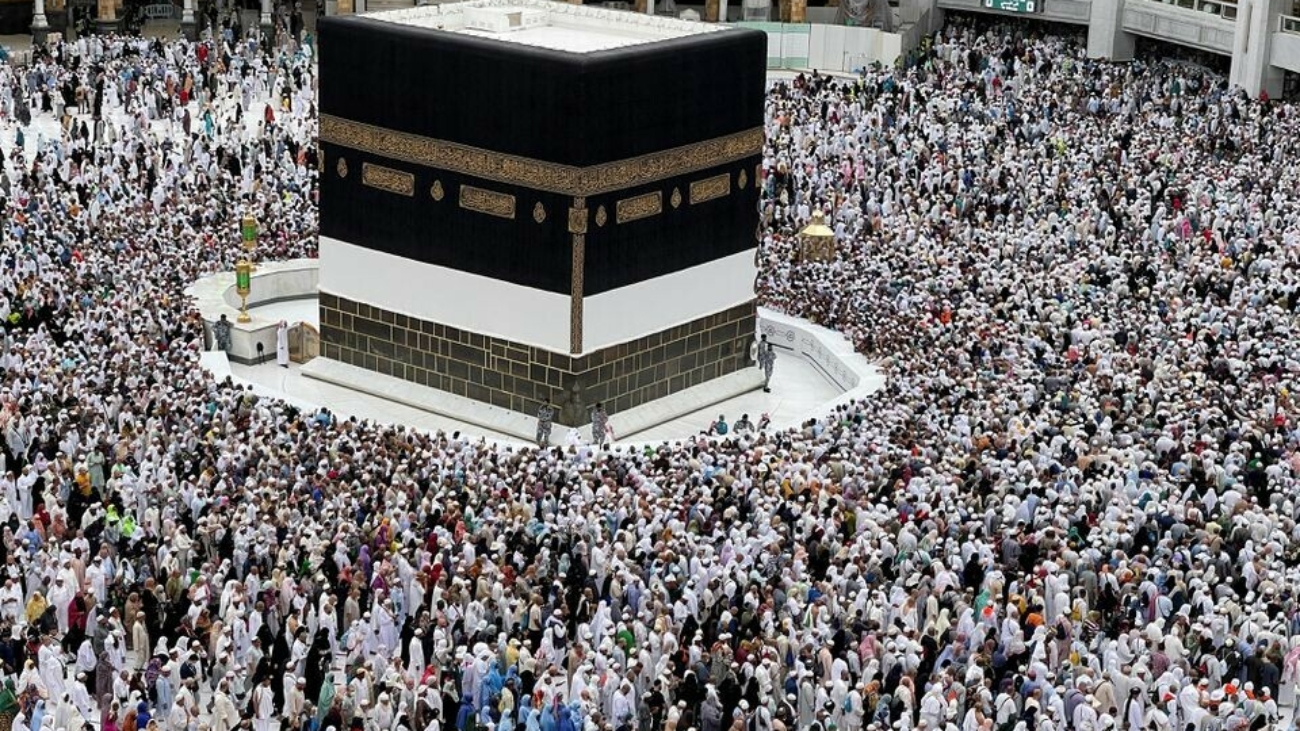
Upon reaching Mecca, pilgrims perform Tawaf, which involves circumambulating the Kaaba seven times in a counterclockwise direction. The Kaaba represents the unity of Muslims worldwide and symbolizes the House of Allah.

Step 3 Sa’i: The Ritual Walk

Following Tawaf, pilgrims undertake Sa’i, which involves walking back and forth seven times between the hills of Safa and Marwa. This ritual commemorates the search for water by Ibrahim’s wife, Hagar, when she was left in the desert with their infant son, Ismail.

Step 4 Wuquf: Standing at Arafat

The pinnacle of Hajj is the Wuquf, where pilgrims gather in the plain of Arafat, located just outside Mecca. It is believed that the Prophet Muhammad (peace be upon him) delivered his farewell sermon at this very place. Pilgrims spend the day in prayer and contemplation, seeking forgiveness and divine blessings.

Step 5 Muzdalifah

The fifth step of Hajj is to go to Muzdalifah, which is a valley between Arafat and Mina. Muzdalifah is also known as Mash’ar al-Haram (the Sacred Monument), where Prophet Muhammad (PBUH) prayed and supplicated after leaving Arafat.

Pilgrims go to Muzdalifah after sunset on the Day of Arafat, and spend the night there under the open sky. They pray the Maghrib (sunset) and Isha (night) prayers combined and shortened at the time of Isha. They also collect pebbles for the next step of Hajj, which is stoning the devil. They pick up 49 or 70 small stones, depending on whether they intend to stay in Mina for two or three days.

Step 6 Stoning of the Devil

After Wuquf, pilgrims proceed to Mina, where they perform the symbolic stoning of the Devil. This ritual involves casting pebbles at three pillars, symbolizing the rejection of evil temptations faced by Ibrahim during his encounter with the Devil.

Step 7 Eid al-Adha: The Festival of Sacrifice

Hajj culminates with the celebration of Eid al-Adha, the Festival of Sacrifice. Pilgrims offer animal sacrifices, following the tradition of Ibrahim, who was willing to sacrifice his son as an act of obedience to Allah. The meat from these sacrifices is distributed among the needy, promoting acts of charity and compassion.

The Importance of Hajj In Islam

Hajj holds immense importance for Muslims both individually and collectively. Here are some key reasons why Hajj is considered a fundamental aspect of Islamic faith:

Spiritual Purification and Renewal

Hajj provides an opportunity for religious purification and renewal. Pilgrims try to start over by putting aside all of the things in the world that distract them and putting all of their attention on their loyalty to Allah. It is a time of serious meditation, introspection, and spiritual growth.

Muslim unity

Hajj is a significant symbol of unity among Muslims from various origins. It brings individuals of many races, ethnicities, and cultures together, promoting a sense of brothers and sisterhood that crosses societal borders. Muslims stand shoulder to shoulder, dressed identically, to demonstrate their equality and togetherness.

Commemorating Prophet Ibrahim’s Sacrifice

Hajj celebrates the Prophet Ibrahim’s highest act of obedience. It reminds Muslims of the ideals of submission, sacrifice, and unshakable faith in Allah. The rites conducted during Hajj represent the struggles and successes encountered by Ibrahim and his family, motivating believers to emulate their devotion and tenacity.

Seeking Forgiveness and Mercy

Hajj is a once-in-a-lifetime chance for Muslims to seek Allah’s mercy and kindness. It is considered that earnest supplications made during the journey are more likely to be accepted. Pray to Allah for forgiveness, blessings, and guidance, humbling themselves before their Creator.

What Makes Us Who We Are:

Hajj strengthens the faith, community, and culture of Muslims. It deepens one’s understanding of Islamic principles and fosters a sense of belonging among Muslims all around the world while strengthening the traits of compassion, tolerance, and selflessness. Pilgrims’ minds and souls are profoundly changed by the Hajj, shaping the rest of their spiritual journey.

Conclusion

The Hajj is a life-changing experience that tests one’s faith, dedication, and personal growth. In doing so, Muslims around the world have shown their unity, diversity, and resiliency. The rituals of Hajj not only aim to reacquaint Muslims with their illustrious past, but also to encourage and direct them toward a life of virtue and significance. I pray that those who make this pilgrimage will experience peace, blessings, and contentment along the way.

Frequently Asking Question

What is the difference between Hajj and Umrah?

Hajj is performed only in the month of Dhul-Hijjah, while Umrah can be performed at any time of the year. Hajj has more rites and obligations than Umrah, such as staying at Arafat, Muzdalifah and Mina, and sacrificing an animal. Hajj is obligatory once in a lifetime for those who can afford it, while Umrah is recommended but not mandatory.  

Why is Hajj performed?

Hajj is performed to fulfill the command of Allah and to follow the example of Prophet Muhammad (peace be upon him) and the earlier prophets. Hajj is also a means of seeking forgiveness, purification, spiritual growth, unity and solidarity among Muslims.  

For whom is Hajj obligatory?

Hajj is obligatory for every adult Muslim who is sane, free and able to perform it physically and financially. This means having enough health, wealth, safety and provisions to travel to Mecca and back without causing harm or hardship to oneself or one’s dependents.

 What does ihram mean?

 Ihram is a sacred state that a pilgrim enters before performing Hajj or Umrah. It involves wearing two pieces of white unstitched cloth for men, and modest clothing for women, as well as abstaining from certain actions such as cutting hair or nails, wearing perfume, hunting etc. Ihram also signifies the equality and simplicity of all pilgrims before Allah.